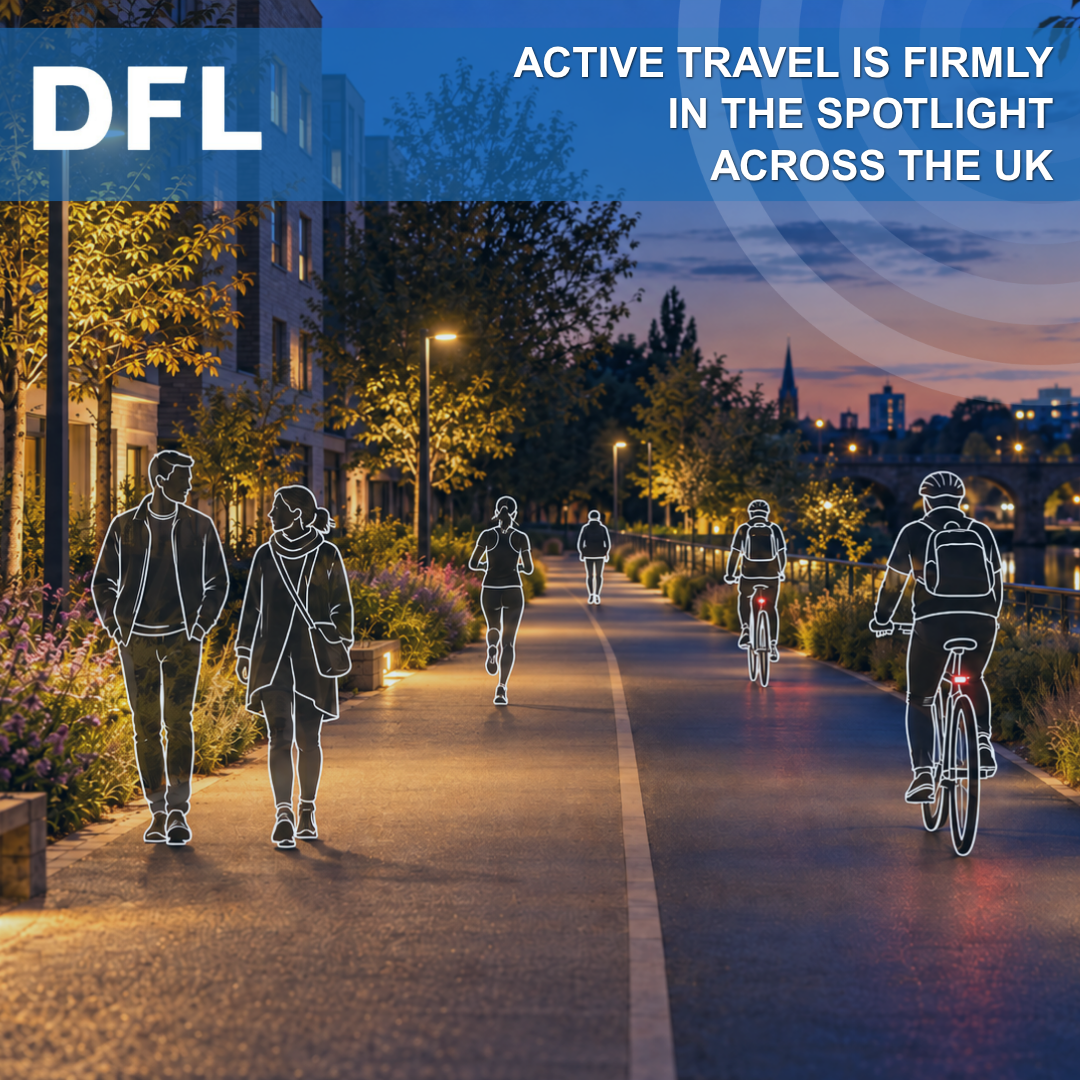
The Government’s Cycling and Walking Investment Strategy, published jointly by the Department for Transport and Active Travel England in June 2026, injects more than £4.5 billion of investment over the next five years, with plans to work alongside local authorities to deliver 5,000 new walking, wheeling and cycling routes and 10,000 safer crossings by 2030.
The scale of the programme means the quality of those routes – including how effectively they are lit – will be crucial to whether people feel confident using them throughout the day and night and throughout the seasons of the year.
Thankfully Active Travel England’s current design guidance makes clear that lighting has an important role to play.
In its guidance for planning active places, Active Travel England says good lighting can help people walking, wheeling and cycling feel safe when travelling at night and allows people to remain active when natural daylight disappears, particularly during the winter.
Its position is unequivocal: “It is a vital element in creating active places.”
Lighting is about more than brightness
For designers, local authorities and lighting professionals, the guidance goes considerably further than simply recommending that active routes should be illuminated.
Active Travel England says routes should be thoroughly and consistently lit and warns that lighting should not be obstructed by trees or other vegetation. It also highlights the importance of avoiding dark areas and shadows, while considering reflection, glare and significant variations in lighting levels.
The physical position of lighting infrastructure matters too. Lighting needs to be treated as an integral part of street design rather than an addition made at the end of a scheme, with columns positioned so they do not create hazards for pedestrians, wheelchair users or cyclists.
For DFL, that is music to our ears.
By 2035, the Government wants 55% of short journeys in towns and cities to be walked, wheeled or cycled, while its strategy also aims for 60% of children aged five to 16 to travel actively to school.
Those ambitions inevitably raise questions about how routes operate during darker winter mornings, evening commutes and journeys after sunset – conditions in which perceptions of safety can significantly influence whether people choose an active journey.
With 10% of women and 6% of men citing ‘poor street lighting’ as a barrier to them taking more walks, it’s clear that passenger-centred design needs to be planned from the start.
Experience matters in active-route lighting
DFL has spent 25 years working within the lighting industry and has completed numerous wayfinding, cycle-route and public-realm lighting projects during that time, such as Walnut Bridge in Guildford and Bush Hill Park Cycle Path. This kind of experience is particularly relevant as local authorities and project teams look to create routes that are not only compliant, but intuitive, comfortable and attractive to use after dark.
Lighting for active travel is rarely just a case of meeting a target illumination level. Successful schemes need to consider how people move through a space, how routes connect, where users may feel vulnerable and how lighting can support both orientation and a sense of security.
Wayfinding is especially important on longer or more complex walking and cycling routes. A well-considered lighting strategy can help reinforce route hierarchy, highlight crossings and junctions, improve legibility and give users greater confidence that they are following a clear and continuous path.
Designing for people and the environment
Crucially, Active Travel England does not advocate a one-size-fits-all approach.
Its guidance recognises that historic, rural and ecologically sensitive locations may require different solutions. Parks, development edges and other environmentally sensitive routes, for example, may not always be suitable for conventional lighting columns.
The message for the next generation of active-travel schemes is therefore increasingly clear.
Building thousands of kilometres of routes will be only part of the challenge. Creating infrastructure that people genuinely want to use – after dark as well as during daylight – will require lighting to be considered from the earliest stages of design.
At DFL, we are passionate about the project we work on. If you have a public realm space that needs the DFL touch, email us, or fill in the Quick Quote form found at the top right of this page.
Further reading:
Active Travel stats – NTS Active Travel Stats 2025
Making Active Travel Conference programme 2026 – Read about the topics discussed at this years conference
Active Travel England – Active Travel England and lighting design
Read our case study on the Bush Hill Park Cycle Path – Cycling and active travel made safer in North London