When preparing a planning application, it’s common to hear the terms ‘Ecological Lighting Assessment’ and ‘Lighting Impact Assessment’ used interchangeably.
The problem is they’re not the same thing.
While both consider the effects of artificial lighting, they answer very different questions and are typically prepared by different specialists.
Understanding that distinction can help developers avoid planning delays, unnecessary redesigns and costly assumptions later in the project.
It starts with Ecology
Ecological Lighting Assessments are typically prepared by an ecologist.
Its purpose is straightforward: to limit artificial lighting to avoid impacts on ecologically sensitive species and habitats.
Using ecological survey data, an ecologist may assess the following for their ecological lighting assessment:
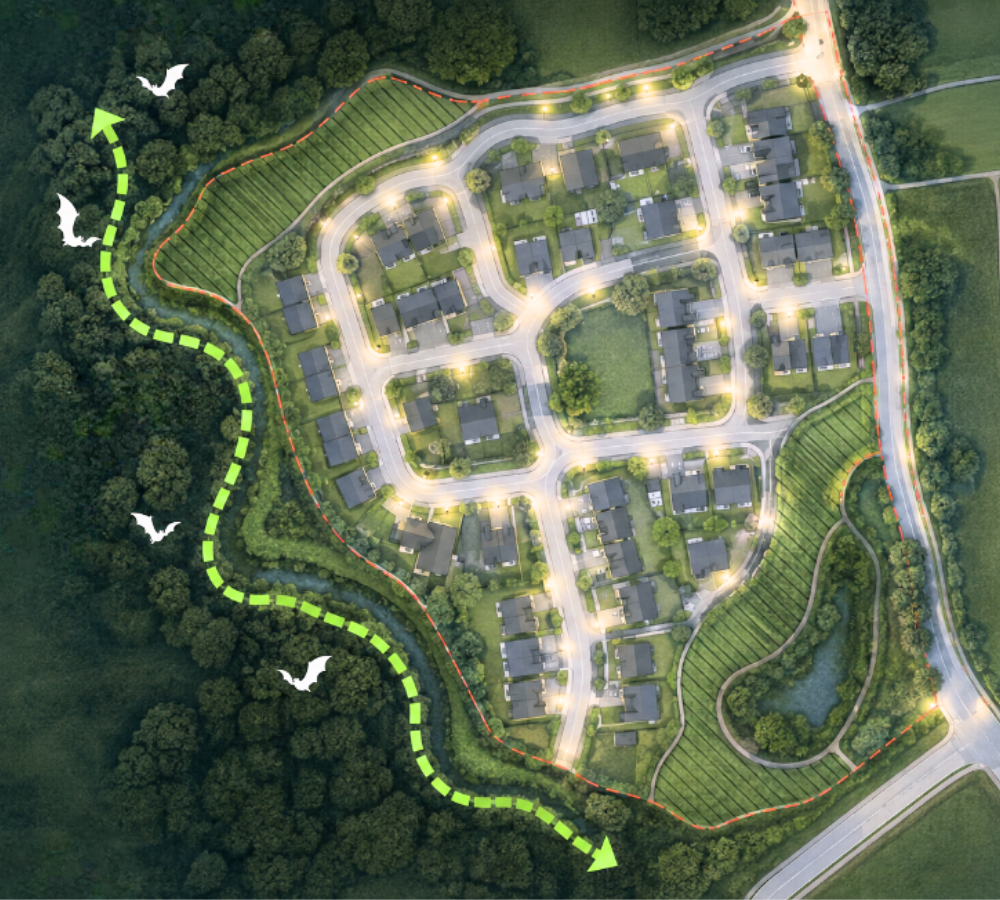
- Will lighting affect bat commuting routes or foraging areas?
- Could it disturb nesting birds or other protected species?
- Will hedgerows, woodland edges or watercourses become illuminated?
- Are dark ecological corridors being maintained?
- What lighting constraints are needed to protect biodiversity?
These assessments are incredibly valuable because they identify the ecological constraints that the lighting design needs to respect.
But that’s exactly what they are; ecological assessments.
They identify the problem.
They don’t necessarily provide the most appropriate lighting solution.
Then comes the lighting strategy
A ‘Lighting Impact Assessment’ takes those ecological constraints and asks a much broader question:
How can we design a lighting scheme that protects ecology while also satisfying planning policy, human amenity, safety, operational requirements and technical lighting standards?
That’s where a specialist lighting consultant adds value.
A comprehensive Lighting Impact Assessment considers far more than protected species. It also assesses:
- Light spill onto neighbouring properties
- Glare affecting drivers and pedestrians
- Sky glow and dark sky compliance
- Landscape and visual impact
- Human amenity
- Public safety
- Compliance with ILP Guidance Notes for the Reduction of Obtrusive Light
- Appropriate lighting levels for the intended use
- Luminaire selection and optical performance
- Lighting controls, dimming and operating hours
- Vertical illuminance calculations
- Lux contour drawings
- How the proposed lighting strategy mitigates ecological impacts while remaining practical and compliant
Rather than simply identifying where lighting could be a problem, a Lighting Impact Assessment demonstrates how those problems are resolved through good lighting design.
Different specialists. Different expertise.
Here’s a simple way to think about it.
You wouldn’t ask your lighting consultant to write your bat survey…
So why would you ask your ecologist to write your Lighting Impact Assessment?
Ecologists are experts in ecology.
Lighting consultants are experts in lighting.
Both disciplines are essential to a successful planning application but they’re not interchangeable.
An ecologist can identify that a bat corridor should remain below a specified illuminance.
A lighting consultant determines how to achieve that through appropriate luminaire selection, mounting heights, optics, shielding, aiming angles, lighting controls and detailed calculations.
Those are two very different skill sets.
Why does this matter for planning?
Planning officers aren’t simply interested in whether lighting could affect bats.
They also need confidence that the proposed lighting:
- Is appropriate for the development
- Protects neighbouring residents
- Minimises obtrusive light
- Supports road and pedestrian safety
- Complies with current guidance
- Meets planning policy requirements
- Protects the character of the night-time environment
- Responds appropriately to ecological constraints
That’s why a Lighting Impact Assessments should be underpinned by a robust lighting strategy, that demonstrates how all these considerations have been balanced.
What should a Lighting Impact Assessment include?
A robust Lighting Impact Assessment should typically include:
- A comprehensive lighting strategy
- Existing and proposed lighting layouts
- Lux contour drawings
- Vertical illuminance calculations
- Light spill assessments
- Obtrusive light analysis in accordance with ILP guidance
- Ecological constraints identified by the project ecologist
- Luminaire specifications
- Lighting controls, including dimming and switching regimes
- Justification for lighting levels and mounting heights
- Evidence of dark sky compliance, where appropriate
- Evidence of how effects on sensitive receptors have been mitigated
- Mitigation measures required to achieve the objectives
Together, these documents provide planning officers with confidence that the proposed lighting has been designed responsibly, balancing functionality, environmental protection and operational requirements.
A collaborative approach delivers the best outcome
The most successful projects don’t choose between an ecologist and a lighting consultant.
They use both at the right stage of the design process.
The ecologist identifies the ecological constraints.
The lighting consultant develops a technically compliant Lighting Impact Assessment that responds to those constraints while also addressing planning policy, human amenity, landscape impact, safety and long-term performance.
The result is a coordinated lighting strategy that is far more likely to satisfy planning officers, ecological consultees and local authorities first time.
Why choose DFL?
At DFL, we work alongside ecologists not instead of them.
Where ecological surveys identify sensitive species or habitats, we use that information to develop a lighting design that protects biodiversity while also satisfying the wider planning application requirements expected by planning authorities.
Our Lighting Impact Assessments don’t just identify potential issues, they demonstrate practical, compliant lighting solutions that support successful planning outcomes.
Before you submit your planning application…
Ask yourself:
- Has your ecologist identified any ecological lighting constraints?
- Has a specialist lighting consultant demonstrated how those constraints will actually be achieved through the lighting design?
- Does your Lighting Impact Assessment address ecology, planning policy, human amenity, safety and dark sky compliance as part of a single coordinated strategy?
If not, then contact DFL, we have the right experts ready and waiting to guide you.
If you want to know more about the affect of artificial lighting on bats – follow this link to our Bat-friendly Lighting page